GMC Big Brake Kits: Wheel Clearance, Fitment, Options
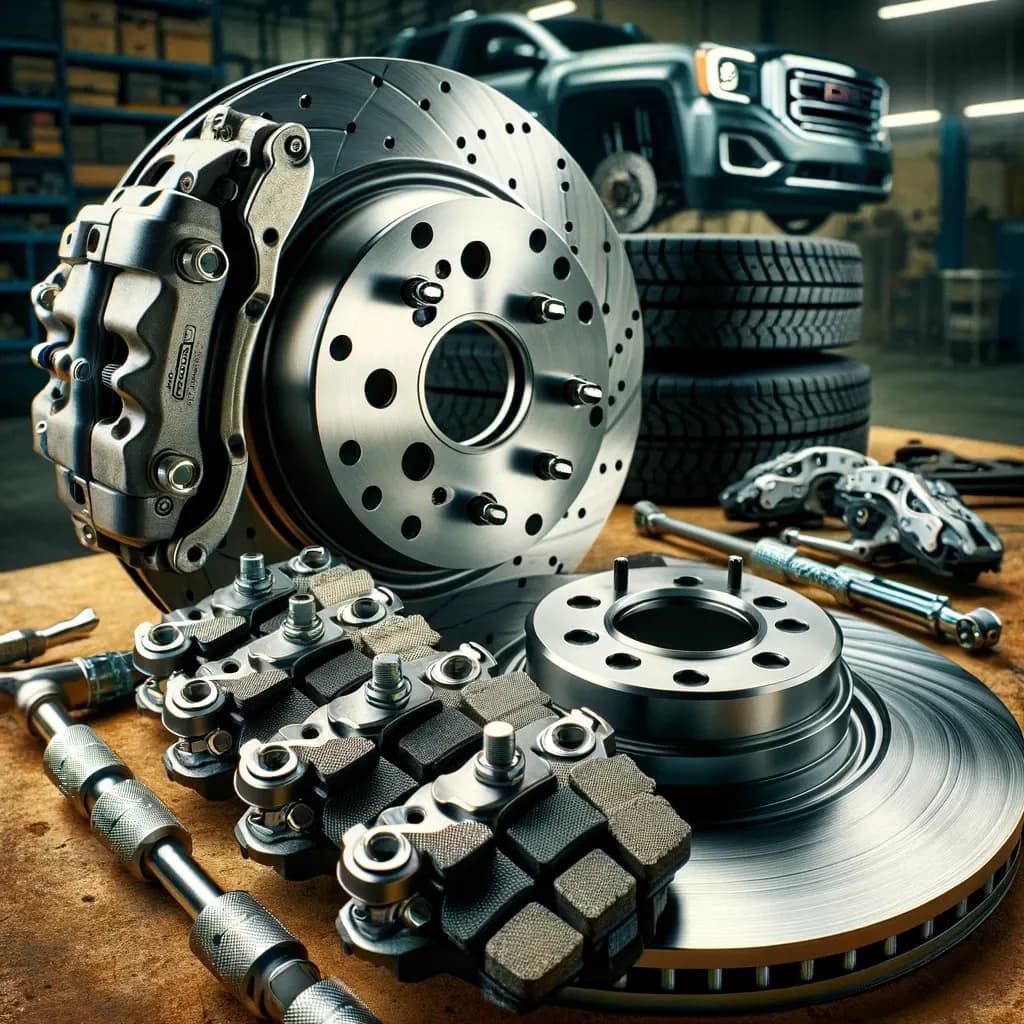
A big brake kit swaps a GMC truck's front calipers and rotors, and sometimes the rears, for larger rotors and multi-piston calipers. The payoff is more heat capacity and less pedal effort when towing or descending mountain grades, not a big change in everyday stopping. The deciding factor is wheel clearance: most 16-inch-rotor kits for the Sierra 1500 need 20-inch wheels at minimum, and even then the spoke design has to clear the caliper.
What a Big Brake Kit Actually Changes
| Component | Stock (typical) | Big brake kit | What you gain |
|---|---|---|---|
| Front rotor | Factory diameter for the smallest wheel offered | Larger diameter, often wider | More leverage and more mass to absorb heat |
| Front caliper | Floating caliper, usually one or two pistons | Fixed caliper with four or six pistons | More even pad clamping, larger pad area, firmer feel |
| Pads | OE compound | Larger pad, kit-specific compound | Higher heat tolerance |
| Hoses | Rubber | Often braided hoses supplied or offered | Slightly firmer pedal |
The bigger rotor and pad mainly raise thermal capacity: how much heat the system can absorb before it fades. That matters most on a loaded truck on a long downgrade. For a short, single stop on dry pavement, tires usually set the limit, so don't expect a kit alone to transform panic-stop distance.
When a Big Brake Kit Makes Sense
- You tow near your truck's rating, especially in hills or mountains, and still feel fade after fixing fluid, pads and trailer brake gain.
- You already run 20-inch or larger wheels and want the brakes to match.
- The truck carries heavy loads regularly and the stock front brakes overheat.
It's usually not the right first move if the complaint is a soft pedal (usually fluid or air), pulsation (usually runout), or pulling (usually a caliper or hose problem). Our GMC brake warning signs chart helps sort those out. For cheaper upgrades to try first, see top aftermarket brake upgrades for the GMC Sierra.
Wheel Clearance: Check This Before You Buy
Wheel clearance is the most common reason a kit gets returned. Three things have to fit:
- Wheel diameter. Manufacturers set a minimum wheel size for each kit. Wilwood lists its 14.25-inch front kits for GM half-ton trucks as needing 18-inch wheels and its 16-inch rotor kits as needing 20-inch wheels (Wilwood). The GM Accessories Brembo kit with 410 mm rotors is listed for 20- to 22-inch wheels.
- Spoke profile. A wheel can be the right diameter and still hit the caliper if its spokes curve inward near the barrel. Wilwood's product pages tell buyers to verify clearance against the kit's wheel clearance diagram before purchase (Wilwood kit page). GM designed its Brembo caliper to clear more than 20 GM production and accessory wheel profiles.
- Offset and wheel weights. Aftermarket wheels with a different offset, or clip-on balance weights inside the barrel, can reduce clearance. Ask the tire shop to use adhesive weights placed where they won't contact the caliper.
Practical test: before ordering, measure your wheel against the manufacturer's clearance template, or bring a wheel to a shop that has the caliper in stock. If you plan to change wheels later, pick the kit that fits the smallest wheel you might run, including a winter set.
The spare matters too. If the spare is smaller than the kit's minimum, it won't fit over the front calipers. A flat on the front axle then means swapping a rear wheel forward.
Verified Kit Options for GMC Trucks
| Kit | Rotor / caliper | Minimum wheel | Fitment (per manufacturer) |
|---|---|---|---|
| GM Accessories Brembo front upgrade | 410 x 32 mm Duralife rotors, red six-piston fixed aluminum calipers | 20 in (20-22 in listed) | Sierra 1500; GM has offered versions for 2008-2018 and 2019-newer trucks, plus Yukon |
| GM Accessories rear brake upgrade | Rotors with red-painted calipers | Check listing | Sierra 1500; designed to work with the production parking brake |
| Wilwood Aero6 front kit | 14.25 in rotors, six-piston caliper | 18 in | Most 2000-2018 GM half-ton trucks and SUVs |
| Wilwood TC6R / TX6R front kits | 16 in rotors, six-piston caliper | 20 in | Most 2000-2018 GM half-ton trucks and SUVs |
| Wilwood Aero4 rear kit | 14.25 in rotors, four-piston caliper | Check listing | GM half-ton trucks |
Always confirm fitment by year, drivetrain and axle with the manufacturer's lookup or your VIN. Kits are specific to spindle and hub design, and the 2500HD/3500HD use different hardware from the 1500. Wilwood also lists kits for Sierra 2500 and 3500 pickups; use its fitment lookup for those. For more on the factory-backed option, see Brembo brakes for GMC.
ABS, Master Cylinder and Brake Balance
A well-engineered kit is designed around the truck's existing hydraulics. Wilwood states that its TC6R truck kit is engineered to be compatible with the OE master cylinder output and to retain full ABS function. The GM/Brembo kit is a GM-developed accessory for the trucks it's listed for.
Mixing and matching parts from different sources is where problems start. A large front caliper paired with a stock rear can shift front-to-rear balance, and caliper piston area that doesn't match the master cylinder can change pedal travel. Buy a matched kit, and add a rear kit only if the manufacturer designed it to pair with the front.
Installation and Break-In
- Installer: a big brake kit bolts on, but it involves caliper brackets, hoses and bleeding. If you're not comfortable with torque specs and bleeding procedures, have a shop do it. See how to bleed GMC Sierra brakes.
- Bedding: follow the kit maker's bedding procedure for the pads. GM's owner's manual also advises avoiding hard stops for the first 200 miles or so on new brake linings.
- Pad-life system: if the kit's pads don't use GM's wear sensors, the Sierra's brake pad life system can be turned off, according to the owner's manual. See GMC brake pad wear sensors.
- Fluid: use the DOT type on your reservoir cap and bleed thoroughly.
Ownership Costs After Install
Kit pads and rotors are usually specific to the kit, so replacements cost more than stock parts and may not be on the shelf at a local parts store. Before buying, check that replacement pads and rotors for the kit are easy to order. Maintenance otherwise follows the normal routine: inspect at each tire rotation, keep caliper hardware clean, and change fluid on schedule. See the GMC brake system maintenance guide.
On warranty: the FTC says using aftermarket parts doesn't by itself void a vehicle warranty; the manufacturer or dealer must prove the part caused the damage to deny coverage. A leased truck may have its own modification rules, so read the lease.
Frequently Asked Questions
Will a big brake kit fit my stock GMC wheels?
Only if your wheels meet the kit's minimum size and pass its clearance template. Many 16-inch-rotor kits for the Sierra 1500 need 20-inch wheels, and 14.25-inch kits typically need 18-inch wheels. Spoke shape can still interfere even at the right diameter.
Does a big brake kit shorten stopping distance?
On a single dry stop, tires are usually the limit, so the change may be modest. The clearer gain is fade resistance and lower pedal effort during repeated stops, towing and long descents.
Do I need to upgrade the rear brakes too?
Not usually for a front kit designed for your truck. Add a rear kit only if the manufacturer designed it to pair with the front kit, so brake balance stays correct.
Is the GM Brembo kit a factory option?
It's sold through GM Accessories and GM dealers for listed Sierra 1500 and Yukon model years, with GM-designed fitment. Confirm your truck's exact year and configuration with a dealer or the parts lookup.
Can I keep my winter wheels with a big brake kit?
Only if they meet the kit's minimum diameter and clearance. Smaller winter wheels are a common reason owners choose a kit sized for 18-inch wheels.
Safety note: This guide is for general informational purposes. Brake systems are safety-critical — if you're unsure at any step, or the work requires specialized tools, have it inspected or completed by a qualified technician.
Related Guides
 GMC Brakes
GMC Brake Pedal Pulsation and Steering Shake: Causes
A pulsing pedal or shaking wheel under braking usually means uneven rotor thickness from pad deposits, not a heat-warped rotor. How to find and fix it.
 GMC Brakes
GMC Brake Noise Chart: What Each Sound Means
Match your GMC brake noise, from squealing and grinding to creaking when the pedal is pressed, to its likely cause and how urgently to act.
 GMC Brakes
GMC Brake Error Message: Causes and Solutions
A GMC brake error often traces to wheel speed sensors, low brake fluid, the ABS module, or wiring. See the symptoms, diagnostic steps, and fixes.
 GMC Brakes
What Does GMC Lifetime Brake Service Really Cover?
GMC lifetime brake service covers replacement pads for as long as you own the vehicle, but not labor, rotors, calipers or fluid. See if it's worth it.
 GMC Brakes
GMC Brake Booster: Vacuum vs. Hydroboost Explained
A GMC brake booster multiplies pedal force using engine vacuum or power steering pressure. Learn which type your truck has and how to test it.
 GMC Brakes
GM Throttle Body Fix for 2021 GMC Canyon Duramax Diesel
GM Special Coverage N242445290 covers a throttle body calibration fault on the 2021 GMC Canyon 2.8L Duramax. Learn the symptoms and the free dealer fix.
More in GMC Brake Problems
- Rear Disc Brake Conversion for GMC Sierra 1500 (2005-2013)
- 2008 GMC Yukon Brake Light Bulb Size (2007-2014 Chart)
- GMC Envoy Third Brake Light and Moulding (2002-2009)
- GMC Yukon Brake Replacement Cost: Pads, Rotors, Calipers
- How GMC Brake Systems Work: Hydraulics to StabiliTrak
- GMC Brake Maintenance: Intervals, Fluid, Towing, Winter
- GMC Canyon Brake Problems and Recalls by Generation
- GMC Yukon Brake System Guide (2015-2023)
- How to Bleed GMC Sierra Brakes: Sequence and Steps
- Changing Rear Drum Brakes on a 2007-2013 GMC Sierra 1500
- GMC ABS Brakes: How They Work and Why the Light Comes On
- GMC Sierra & Yukon Brake Line Diagram and Repair Guide